



Jul
31,
2026
Topcase or side panniers: the right choice depends on capacity, mounting system and the kind of riding you actually do. Here's how to judge ...


World's Fastest Online Shopping Destination
Jul
31,
2026
Topcase or side panniers: the right choice depends on capacity, mounting system and the kind of riding you actually do. Here's how to judge ...
Jul
17,
2026
An enduro helmet isn't a motocross helmet or a street helmet: the difference lies in the removable visor, the approval standard and the ...
Jul
09,
2026
The stock shock is the first component manufacturers save money on. Here is what changes with a Bitubo, the differences between CLU, CZE, WMB and ...
Jul
07,
2026
Full-face, jet, modular, crossover or enduro: every motorcycle helmet is designed for a specific use. Here's how to recognize the real differences ...
Jul
06,
2026
Convertible modular helmets with a flip-up chin guard at 180° combine the protection of a full-face helmet with the comfort of a jet helmet. Here ...
Oct
29,
2025
The Complete Guide to Your Electrical System's Guardian
Oct
29,
2025
The Complete Guide to Your Vehicle's Electrical Heart

If you've ever heard that annoying whistle or squeal coming from your motorcycle's brakes during braking, you know how concerning it can be. In this comprehensive guide, we'll analyze all the technical causes of brake squealing, effective solutions, and tips to prevent this common but solvable problem.
Brake squealing or whistling is an acoustic phenomenon that occurs when the motorcycle's braking system produces high-frequency vibrations during braking. Contrary to what many think, it doesn't always indicate a serious problem, but it's important to understand the causes to ensure maximum safety.
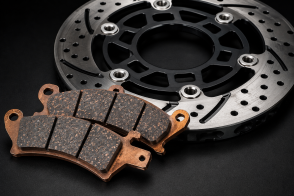
The braking system works through friction: when you brake, the pads are pushed by the caliper against the brake discs, generating the force needed to slow down or stop the motorcycle. During this process, a minimal amount of energy is not converted into heat but is released as high-frequency sound vibrations, producing that characteristic squeal.
Brake squealing is particularly common in modern motorcycles equipped with high-performance brakes. In fact, since asbestos was banned from industrial production due to its toxicity, substitute materials (such as sintered pads composed of bronze, graphite, iron and ceramic material) guarantee superior performance but are more subject to resonance phenomena.
The most common cause
Pads are components subject to continuous wear. When thickness drops below 2-3 millimeters, the metal backing can come into direct contact with the brake disc, causing:
How to recognize it:
Solution: Immediate pad replacement. For motorcycles, replacement is recommended when thickness reaches 3mm. Discover our complete selection of motorcycle and scooter brake pads from all brands.
What does "glazing" mean?
When pads are subjected to very high temperatures (typically during intense and prolonged braking, such as on mountain descents), the friction material surface can crystallize, becoming hard and slippery like glass.
Consequences:
Solution: Lightly sand the pad surface with fine sandpaper (120-180 grit), or replace pads if problem persists.
How do discs get damaged?
Brake discs can develop grooves, scratches or deformations (warping) due to:
Distinctive signs:
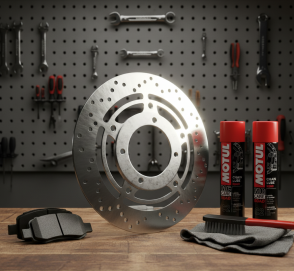
Solution: If grooves are superficial (< 0.5mm), discs can be machined by a professional. If wear is deep or disc is warped, replacement is necessary. Find quality brake discs for your motorcycle model.
The most complex technical problem
Modern sintered pads have a low coefficient of elastic deformation, making them rigid and more subject to vibrations. The friction material continuously attempts to "mesh" with the disc's microporosities, but always having a free margin of movement, the pad vibrates at very high frequency.
Characteristics:
Solution: Application of anti-squeal spray or paste on the metal back of pads (never on friction surface!) or installation of anti-vibration springs if provided by manufacturer.
Bedding in is fundamental
New pads require a bedding-in period of about 100-200 km during which:
If not properly bedded in:
How to perform correct bedding in:
Professional tip: Before installation, slightly chamfer pad corners with a file to eliminate harder areas.
Temperature and humidity affect brakes
The squealing problem intensifies with:
Solution: Use of anti-seize pastes resistant to high temperatures and water-resistant specific products for humid seasons.
Invisible enemies of the braking system
Dust, dirt, oily residues and debris can accumulate between:
Effects:
Solution: Periodic cleaning with compressed air or specific brake cleaners (never oily products!). Also check and clean cylinder seals.
Temporary problem after inactivity
If the motorcycle sits for weeks or months, brake discs (especially if untreated steel) can develop a thin layer of surface rust.
Characteristics:
Solution: Perform some progressive brakings (brake bedding) to remove oxide layer. Rust eliminates automatically with use.
1. Pad Inspection
Check thickness by looking through inspection hole on caliper or by removing wheel:
Also verify:
2. Brake Disc Inspection
Examine disc surface:
Measure thickness with caliper:
3. Road Test
Perform these tests safely:
Note:
When necessary:
Recommended replacement interval:
Tip: Always replace pads in pairs (both calipers) to ensure uniform braking.
Essential product against resonance
Anti-squeal sprays and pastes are composed of materials that dampen high-frequency vibrations.
How to apply correctly:
Recommended products:
Duration: Effect lasts about 2,000-5,000 km, then needs reapplication.
Prevention before installation
Before installing new pads, perform this procedure:
Why it works: Pad corners tend to harden during warehouse storage. Chamfering prevents initial whistling.
Fundamental routine maintenance
Materials needed:
Procedure:
Recommended frequency: Every 5,000 km or at least twice yearly.
Recovery of partially crystallized pads
If pads are still above 4mm thickness but glazed:
Attention: This is a temporary solution. If problem returns, replace pads.
When discs are scored but recoverable
Discs with superficial grooves (< 0.5mm depth) can be machined by a specialized lathe operator.
Machining process:
Cost: €30-60 per disc (cheaper than replacement)
When to replace instead of machining:
Correct bedding in of new pads
Avoid excessive overheating
Regular visual inspections
Periodic cleaning
Use quality parts
Proper storage during inactivity
Attention to weather conditions
Appropriate riding style
Brake fluid check
Documentation
| Interval | Check/Service |
|---|---|
| Every 1,000 km | Visual pad thickness check |
| Every 5,000 km | Complete system cleaning + disc inspection |
| Every 15,000-25,000 km | Front pad replacement |
| Every 30,000-40,000 km | Rear pad replacement |
| Every 40,000-60,000 km | Brake disc replacement |
| Every 2 years | Brake fluid replacement |
| Before/after long trips | Complete system inspection |
URGENT - Go to shop immediately if:
IMPORTANT - Schedule visit within few days if:
NORMAL - Can manage yourself if:
Standard braking system check (30-60 min):
A: It depends on the cause. If squealing is due to resonance phenomena with pads and discs in good condition, there's no immediate danger. However, if caused by worn pads or damaged discs, yes, it's dangerous because braking effectiveness is compromised. When in doubt, always have it checked.
A: Absolutely yes, it's completely normal! New pads need a bedding-in period (100-200 km) during which they may whistle. Also, pad corners may be harder from storage. If squealing persists after 300 km, check that:
A: Water creates a lubricating layer between disc and pads that intensifies vibrations and therefore noise. It's a normal phenomenon. After rain, perform 2-3 progressive brakings to dry the system. You can also use water-resistant specific anti-squeal pastes.
A: ABSOLUTELY NOT! Never apply oils, WD-40 or lubricants on braking surfaces (discs and friction side of pads). These products completely compromise braking effectiveness creating extremely dangerous situations. Use only:
A: There's no fixed interval equal for everyone, it depends on:
General indications:
Recommended visual check: Every 5,000 km or per maintenance manual.
A: Yes, generally sintered pads are more subject to whistling because they have a lower coefficient of elastic deformation (they're more rigid). This makes them more prone to resonance phenomena. However, they offer:
Whistling is a small compromise for superior performance. Can be reduced with anti-squeal spray.
A: No, discs should never be sanded manually! Grooves must be removed through professional lathe machining, which guarantees:
"Homemade" sanding would permanently ruin discs compromising safety.
A: Yes, it's typical behavior. At low pressures and reduced speeds, conditions are ideal to trigger resonance. When you brake harder:
It's not necessarily a serious problem, but worth checking pad and disc condition.
A: It depends heavily on environmental humidity:
Surface rust forms naturally and is normal. Eliminates with a few progressive brakings. For inactivity exceeding 1 month, consider protecting discs with temporary protective sprays (to be removed before use!).
A: Generally 2,000-5,000 km, depending on:
It's a maintenance service to be repeated periodically. Some premium products can last even 10,000 km.
A: Depends on aftermarket manufacturer. General rule:
Never save on brakes! It's the most important active safety system. Invest in certified quality products.
Brake squealing is a common problem that, in most cases, can be solved with routine maintenance and preventive measures. The key is:
Remember: brakes are your motorcycle's most important safety system. When in doubt, an extra check from a professional is always better than risking.
At ML Moto you'll find everything needed to keep your braking system in perfect condition:

Comments : 0